|
Carbon Nanotubes (CNT):
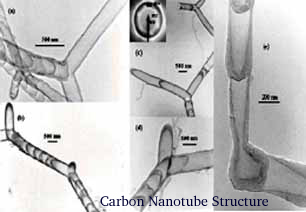 An important activity at IITB has been the
synthesis of Carbon Nanotubes — a sequence of C60 atoms arranged
in a thin cylindrical structure. CNTs find
uses in ultra-capacitors, solar cells, diodes and transistors.
Such CNTs can be produced at low cost, and localized on silicon
and other planar substrates using the Chemical Vapour Deposition
method. An important activity at IITB has been the
synthesis of Carbon Nanotubes — a sequence of C60 atoms arranged
in a thin cylindrical structure. CNTs find
uses in ultra-capacitors, solar cells, diodes and transistors.
Such CNTs can be produced at low cost, and localized on silicon
and other planar substrates using the Chemical Vapour Deposition
method.
Nanomagnetics: A significant application of magnetic technology is
information storage and retrieval. Magnetoresistive sensors made
up of nanostructured multilayers find uses in reading heads of
computer hardware products, in medicine, in surveillance and
manufacturing control, and also in the automobile and aerospace
industries. At IITB, the current focus is on the preparation and
characterization of a series of multilayered products. Systems
under investigation are iron, nickel, cobalt, rare earths, and
their alloys. Nanocomposites of these with non-magnetic and
non-conducting materials such as oxides of silicon, aluminium and
zirconium, are being examined for enhanced magneto-resistance.
Nano-biotechnology: The nano-biotechnology research at IITB
involves an interdisciplinary approach. It encompasses development
of biocompatible nanoparticles for therapeutic use, nanoparticles
as drug delivery agents, and biomaterials and devices for
biological applications.
Nanoparticles for treatment of cancer: A promising therapy for
treatment of cancer involves the selective destruction of cancer
cells by raising their temperatures to 42-56oC. The magnetic
properties of nanoparticles in the presence of an external
alternating magnetic field is used to bring about such localized
hyperthermia. Certain nanoparticles need to be encapsulated with
suitable biocompatible material (such as liposomes) before being
administered intravenously to a patient. A schematic
representation of the treatment is shown in the figure. (Click
here to see figure)
Nanoparticles as drug delivery agents: A research group at IITB is
developing nanoparticles for inhalation in Neonatal and Adult
Respiratory Distress Syndromes. The idea is to mimic the role
played by naturally occurring pulmonary surfactants, which may be
inadequate or dysfunctional in certain respiratory diseases. Yet
another study in progress is the evaluation of the therapeutic
efficacy of Bhasma preparations as nanoparticles in drug delivery.
Bhasmas are extremely fine powders coated with herbal extracts,
used in the Ayurvedic and Siddha systems of medicine.
Biomaterials and devices: Bone defects due to gum diseases or
injuries require bone replacement. Nanocomposites of
hydroxyapatite and bioglass ceramics are being studied as suitable
bone substitutes for dental and maxillo-facial use. Researchers at
IITB are also developing micro-engineered devices to be used in
trans-catheter and endoscopic surgeries.
The Road Ahead
The fundamental knowledge gained through nanoscience will expand
over the coming decades. Accordingly, governments and major
corporations around the world have been committing several billion
dollars annually for the advancement of nanotechnology. The
ever-increasing additions to the repertoire of
nanotechnology-based applications is an indicator of the promise
of nanotechnology as a dominant force in our society.
Faced with the challenge of developing new characterization
techniques, novel systems and devices in the nanoregime, an
institute-wide initiative has been launched to make IITB the
nation's hub for nanotechnology research in the near future.
Acknowledgement: I thank Prof D Bahadur (Deptt. of Met Engg. and
Mat. Science) and Prof S Duttagupta (Deptt. of Electrical Engg.)
whose help and guidance have been invaluable in the composition of
this article. The graphics used in this article have been obtained
from various research groups of IITB....More
on Research Areas in Nanotechnology
|