|
In the current global economic scenario, timely and efficient
management of Intellectual Property (IP) in premier academic and
research institutions has become critical. Apart from producing
skilled manpower, institutes such as the IITs are major generators
of innovative products and services. Most of the IITs have already
initiated institutional IP management activities. For providing a
further fillip to such activities, the IPR unit* of IIT Bombay
organized a two-day Pan-IIT workshop on 'Management of
Intellectual Property in Academia'. Held on the 26th and 27th of
February 2004 at IIT Bombay, the idea of hosting such a workshop
was originally conceived by Prof. Ashok Misra (Director, IIT
Bombay), as a sequel to a Pan-IIT road show conducted in the US
about 6 months ago.
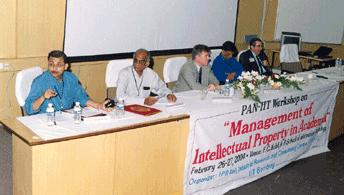 Targeted at all the IITs and other academic institutions , and the
heads of their IPR units, the workshop was unique in the sense
that it was made possible by spontaneous and honorary
participation of several specialist speakers and professionals. Dr
Raj Dave (IIT alumnus, and Patent Attorney, Morrison & Foerster,
USA) was instrumental in bringing in a delegation of distinguished
American IP experts and industry representatives, who provided an
insight into the current status of IPR issues on an international
level. The presentations were followed by lively and highly
interactive panel discussions, which addressed the deeper issues
of IP protection from the standpoint of innovators or creators of
IP, and the institution as a whole. Targeted at all the IITs and other academic institutions , and the
heads of their IPR units, the workshop was unique in the sense
that it was made possible by spontaneous and honorary
participation of several specialist speakers and professionals. Dr
Raj Dave (IIT alumnus, and Patent Attorney, Morrison & Foerster,
USA) was instrumental in bringing in a delegation of distinguished
American IP experts and industry representatives, who provided an
insight into the current status of IPR issues on an international
level. The presentations were followed by lively and highly
interactive panel discussions, which addressed the deeper issues
of IP protection from the standpoint of innovators or creators of
IP, and the institution as a whole.
In a succinct speech, the eminent lawyer, Mr. Ram Jethmalani, who
was present during the inauguration of the event, acknowledged the
superiority and the significance of intellectual property in
today's business environment. However, he also put forth a caveat
on the importance of exercising global control of what could turn
out to be a potentially lethal tool.
The workshop covered a gamut of issues which included the
following:
-
Managing IPR in academia: national and global experience
-
Building Institutional IP Policy for academic institutions:
conflicts, critical issues and challenges
-
Valuation and protection of IP in a global context.
-
IP protection in Technology Transfer: price, royalty stru-c
ctures, other terms and conditions.
-
Experimental exemptions in patents/designs dealing with
selection of projects, assignment of rights, liabili- ties, and
planning research.
-
Case Studies in IPR litigations involving academic institutions
-
Entrepreneurship development and IPR
-
Copyright issues in academics
Several interesting themes emerged from the deliberations; one of
these was the need for evolving a strong institutional IP policy
that would clearly address the inherent complexities in the
creation and dissemination of knowledge. With the overlap of
disciplines and a blurring of boundaries between upstream and
downstream research, issues concerning multiple ownerships can be
expected to arise–especially in externally funded research
projects, and Technology Business Incubation activities. An ideal
policy would therefore be one that successfully protects the
interests of the innovator (student or faculty), the institute,
the sponsor, and the society at large. Such a policy would also
help the institute in developing a coherent philosophy, and in
achieving its Vision and Mission. As noted by Prof. P Ganguli, "in
the present global framework, IPR has come in at the point of idea
generation and the challenge lies in managing it from here up to
commercial production".
On a national scale, the need of the times is a legislation that
will address ownership issues of externally funded projects,
similar to the Bayh-Dole Patent and Trademark Law Amendments Act
of the US (1980). Institutions such as the IITs can impress upon
the government, the need for such legislations.
Next on the Pan-IIT Board's agenda is the organization of a
National Workshop on IPR with large participation from the
industry. The event would aim to highlight the role of IP in
national wealth generation, and inform the industry about the IP
management initiatives in the academia. It would also dwell on the
need for evolving an organizational R&D strategy in the emerging
scenario. The proceedings of the workshop will be shortly brought
out by the institute.
|
List
of speakers
-
Judge Randall R
Rader, Circuit Judge, United States Court of Appeals, USA
-
Prof Martin
Adelman, Professor of Law, George Washington University Law
School, USA
-
Dr Raj Dave, Patent Attorney, Morrison & Foerster, USA
-
Mr R S Minisandram, Executive Director of IP, Seagate
Technology LLC, USA
-
Mr David Simon, Director of IP, Intel Corp. USA
-
Mr Paul Stone, VP and Chief Patent Counsel, Symyx
Technologies Inc.
-
Mr Stephen Durant, Partner, Morrison & Foerster, San
Francisco.
-
Mr Marc Adler, Chief IP Counsel, Rohm & Haas, USA
-
Mr Raghav Saha, Advisor, Department of Science and
Technology, Govt. of India
-
Mr T C James, Deputy Secretary DIPP, Govt. of India
-
Mr Manoj Menda , Advocate
-
Prof P Ganguli, Advisor, Vision IPR, Mumbai
|
* The IPR Unit at IITB: Prof Karuna Jain (Co-ordinator) and Prof
Shishir Kumar Jha (Shailesh J Mehta School of Management), Prof
Prabuddha Ganguli (Advisor, Vision IPR), and Dr Padma Satish (IRCC) |
 Editorial