|
Pulse Tube
Cryo-cooler |
|
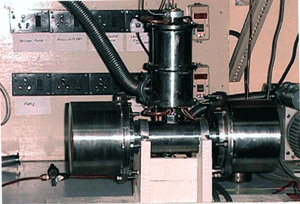 With
funding from the Board of Research in Nuclear Sciences (BRNS),
Prof K G Narayankhedkar, Department of Mechanical Engineering, has
developed a state-of-the-art technology for Stirling type Pulse
Tube Cryo-cooler (15 W capacity at 77K). The technology finds
applications in re-condensation of nitrogen gas for MRI shield
cooling, liquefaction of hydrogen and oxygen for space
applications, and helium liquefaction for SQUID. With
funding from the Board of Research in Nuclear Sciences (BRNS),
Prof K G Narayankhedkar, Department of Mechanical Engineering, has
developed a state-of-the-art technology for Stirling type Pulse
Tube Cryo-cooler (15 W capacity at 77K). The technology finds
applications in re-condensation of nitrogen gas for MRI shield
cooling, liquefaction of hydrogen and oxygen for space
applications, and helium liquefaction for SQUID.
The cooler has a modular compressor design, and produces cryogenic
temperatures without the use of displacers. Hence, it has no
displacer seals, moving cold parts, or vibration, leading to
greater reliability and longer mean time between maintenance
schedules. Additionally, damage to the cold head during operation
is eliminated due to the absence of moving parts.
The
novel design combines two major technical breakthroughs:
-
Dual
opposed pistons driven by moving coil type linear motor using
flexure bearings, minimiz ing compressor vibrations and acoustic
noise.
-
Pulse
Tube with inheritance tube and reservoir
These
features make the Stirling type cryo-cooler more efficient than
other cryo-coolers.
Contact: Prof K G Narayankhedkar,
Mechanical Engg Department, email: nkhedkar@me.iitb.ac.in
|
|
|
|
|
|
Rapid Prototyping Facility |
|
A
state-of-the-art Rapid Prototyping Facility has been recently set
up at IIT Bombay with funds from MHRD under the Technology
Development Mission. The facility has helped diffuse the
technology into the Indian industry. Several companies now employ
the technique for their product development.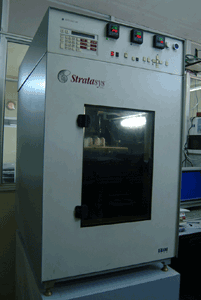
Rapid Prototyping (RP) makes the manufacture of complex 3D objects
as easy and simple as printing a letter, drawing or a picture. In
fact, RP machines are also called ‘3D Printing’ or ‘3D Faxing’
machines! This fairly new and fascinating technology has
revolutionized the way products are designed and manufactured
today. It enables manufacturing of physical objects directly from
their CAD models without any human intervention or use of any
tools, dies, or fixtures specific to the geometry of the objects
being produced. The object is built in an automated layer-by-layer
manner, requiring only a definition of its geometry. Rapid
Prototyping & Tooling (RP &T) has distinct benefits since the
process compresses the product development cycle, and shortens the
tool manufacturing cycle enabling organizations to launch new
products with short lead times.
Objects as large as 25cm x 25cm x 25cm can be made out of plastics
using this facility. Bigger objects can be built in pieces and
joined using adhesives, or mechanically, or both. Its major uses
include: building concept models in various disciplines of
mechanical, aerospace, civil, and bio-medical engineering, and
product design directly from CAD files.
Contact: Prof K P Karunakaran, Mechanical Engg Department, email:
karuna@me.iitb.ac.in |
|
|
|
Design Registrations:
Five designs have been registered with the Office of the
Controller General of Patents, Designs and Trademarks, India,
for ‘Key-Lekh’– a keyboard developed at IIT Bombay for text
input in Indian languages (The product was described in the
previous issue). Webaddress–http://rnd.ircc.iitb.ac.in/~webadm/update/December03/keyboard.html |
|
|
|
|
Home
|
Top
| Previous page |
|
|
|
|
|
|
|
|
|
|
|
 Editorial