|
To
survive and succeed in the global market, manufacturing firms are
churning out innovative products with continual improvements in
price-, quality- and response- competitiveness. Products now
incorporate new features, materials, or technologies with:
additional functionality, better user interface, higher
efficiency, or smaller size. Price competitiveness relies on
manufacturing a product within a target cost given by the target
market price, minus desired profit. Quality competitiveness
involves designing robust products and production systems to get
the quality right–the first time and every time. Response
competitiveness implies faster development and introduction of a
new product by working proactively with respect to customer
expectations.
What
is Collaborative Engineering?
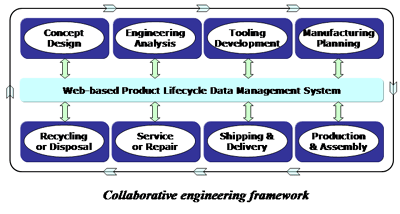
Aggressive innovation by competing firms is leading to more
complex products which require specialist teams to handle
different activities in product lifecycle, such as: concept
design, engineering analysis, tooling development, manufacturing
planning, part manufacture, product assembly, delivery, service,
and disposal. The teams need to work with each other concurrently
to optimise the product, and launch it early in the market.
Concurrent engineering is, however, difficult to practise when the
specialist teams are located in different parts of the world–an
increasing trend with globalisation.
The
solution lies in connecting the team members through a digital
communications network and providing them appropriate software to
create, analyse, and modify a virtual model of the product. The
model and results are stored in digital form in a central or
distributed server, which may be accessed by all team members over
a local area network or Internet. This approach to product
development is referred to as Collaborative Engineering.
Computer-aided Product Development
 The
virtual product comprises a digital assembly of its part models.
The parts are modelled in 3D using computer-aided design (CAD)
programs and saved in standard formats (e.g. IGES and STEP) for
exchange between different programs. Computer-aided engineering
(CAE) programs enable simulating the product mechanism, and
optimising the shape of each part under static or dynamic loads by
simulating the internal stresses. The part models can be sent to a
rapid prototyping system for automatic fabrication of a physical
replica for form, fit and function testing. The tooling models
(moulds, dies, jigs and fixtures) can be quickly developed by
modifying the corresponding part models. Computer-aided
manufacturing (CAM) programs enable planning, simulation and
optimisation of process parameters. Finally, computer-aided
inspection systems enable automatic comparison of virtual and real
parts for quality assurance.
.....more on next page The
virtual product comprises a digital assembly of its part models.
The parts are modelled in 3D using computer-aided design (CAD)
programs and saved in standard formats (e.g. IGES and STEP) for
exchange between different programs. Computer-aided engineering
(CAE) programs enable simulating the product mechanism, and
optimising the shape of each part under static or dynamic loads by
simulating the internal stresses. The part models can be sent to a
rapid prototyping system for automatic fabrication of a physical
replica for form, fit and function testing. The tooling models
(moulds, dies, jigs and fixtures) can be quickly developed by
modifying the corresponding part models. Computer-aided
manufacturing (CAM) programs enable planning, simulation and
optimisation of process parameters. Finally, computer-aided
inspection systems enable automatic comparison of virtual and real
parts for quality assurance.
.....more on next page
|
 Editorial