Editorial Editorial
IRCC Notes
In Brief
Consultancy Projects
Sponsored Projects
MOUs
Awards
Technologies
ASAN: The Low Cost ATM
Bio-Char Unit for Charcoal Production
WebROBOT: Internet Based Robotic Assembly Planning System
Pulse Tube Cryo-cooler
Rapid Prototyping Facility
Design
Registration
Event Highlight
K-Yan: The Compact Media Centre
Pan-IIT Workshop on 'Management of IP in Academia' at IIT Bombay
Techfest 2004: A look back
Articles By
Prema Prakash
B Ravi
Meenakshi Gupta
Narendra Shah
Board of Governors
Archives
Weblinks
Team/Contact
|
|
|
ASAN: The Low Cost ATM |
|
ASAN, a low cost Automated Teller Machine (ATM) was launched on
December 5, 2003. Profs V P Bapat and U A Athavankar of the
Industrial Design Centre designed it, based on a survey of current
and potential users interviewed for their views on existing ATMs.
ASAN has several advantageous features over the currently deployed
ATMs to suit the Indian customer and settings.
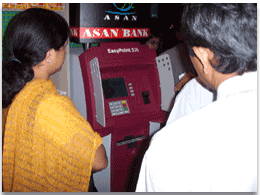 The attractive new design incorporating elements from traditional
Indian architecture departs from the current neutral appearance of
ATMs. Banks may further customize it to a limited degree. The
small size makes it suitable for deployment in places with space
constraints. ASAN's ergonomic design suits the typical Indian body
dimensions with respect to the height of the keypad and the
inclination of the screen. Additionally, the machine has a
provision for keeping one's personal belongings, and protruding
wings for ensuring privacy during transactions. A multi-coloured
card reader status indicator guides users unfamiliar with new
technology like smart DIP card readers. The attractive new design incorporating elements from traditional
Indian architecture departs from the current neutral appearance of
ATMs. Banks may further customize it to a limited degree. The
small size makes it suitable for deployment in places with space
constraints. ASAN's ergonomic design suits the typical Indian body
dimensions with respect to the height of the keypad and the
inclination of the screen. Additionally, the machine has a
provision for keeping one's personal belongings, and protruding
wings for ensuring privacy during transactions. A multi-coloured
card reader status indicator guides users unfamiliar with new
technology like smart DIP card readers.
The machine has NCR-intelligent power-saving hardware and
software. An integrated pedestal accommodates a UPS, providing
maximum availability during outages. The robust engineering design
ensures trouble-free operation in hot, humid and dusty
environments. Additionally, a unique airflow system allows
deployment at non-air conditioned sites. Such features make it
suitable for interior locations. Other features include, 40-column
graphics thermal receipt printer, secure encrypting PIN pad and a
flat panel screen.
Contact: Prof U A Athavankar, IDC,
email: uaa@idc.iitb.ac.in
|
|
|
|
Top |
|
Bio-Char Unit
for Charcoal Production |
|
Indian
manufacturers still use the highly polluting and inefficient 'pit'
method for charcoal production from wood and non-wood waste.
Sponsored by the National Mission on Bamboo Applications (NMBA),
TIFAC, Dept. of Science and Technology, the biomass research group
led by Prof Anuradda Ganesh (Energy Systems Engineering), has
developed a simple to operate, non-polluting Bio-char Unit (BCU).
Although developed for bamboo waste, the unit can be used for
other non-powdery biomass with minor modifications. The uniqueness
of BCU lies in using the otherwise polluting gases as a thermal
energy source. The gases carry 50% of the energy of the biomass
used in charcoal making.
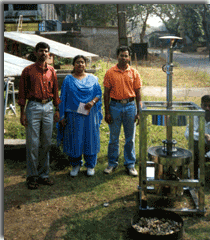 Using
BCU, a uniform yield of 25% charcoal from bamboo waste, and about
28% charcoal from other woody biomass is obtained, with a
consistent calorific value of 28MJ/kg. A batch of 100kg bamboo
waste is converted into 25kg charcoal in two and a half hours. A
single person can operate the unit, which costs Rs. 35,000. A
bio-char unit was set up at an activated carbon manufacturing
plant in Hyderabad, where the suitability of bamboo charcoal as
raw material was successfully demonstrated. Another BCU sponsored
by KVIC is being put up at a bakery unit at Yusuf Mehrauli Centre,
Tara Village, Maharashtra to demonstrate the use of thermal energy
from gases for generating charcoal as a by-product. Through NMBA,
15 such units at five different locations in Tripura, Meghalaya,
Bastar, Amravati and Pune districts are being deployed for
training and further dissemination of the technology. A 10 kg
batch unit was also demonstrated at the VII World Bamboo Congress,
New Delhi. The BCU is expected to help generate rural employment,
and ensure village energy security. Using
BCU, a uniform yield of 25% charcoal from bamboo waste, and about
28% charcoal from other woody biomass is obtained, with a
consistent calorific value of 28MJ/kg. A batch of 100kg bamboo
waste is converted into 25kg charcoal in two and a half hours. A
single person can operate the unit, which costs Rs. 35,000. A
bio-char unit was set up at an activated carbon manufacturing
plant in Hyderabad, where the suitability of bamboo charcoal as
raw material was successfully demonstrated. Another BCU sponsored
by KVIC is being put up at a bakery unit at Yusuf Mehrauli Centre,
Tara Village, Maharashtra to demonstrate the use of thermal energy
from gases for generating charcoal as a by-product. Through NMBA,
15 such units at five different locations in Tripura, Meghalaya,
Bastar, Amravati and Pune districts are being deployed for
training and further dissemination of the technology. A 10 kg
batch unit was also demonstrated at the VII World Bamboo Congress,
New Delhi. The BCU is expected to help generate rural employment,
and ensure village energy security.
Contact: Prof A Ganesh, Energy
Systems Engg, email: aganesh@me.iitb.ac.in |
|
Top |
|
WebROBOT:
Internet Based Robotic Assembly Planning System |
|
Globalization has posed many challenges for product design and
manufacturing due to shorter product life cycles and frequent
design revisions. To realize telemanufacturing, collaborative
CAD/CAM solutions are needed to enable seamless integration of
distributed physical and knowledge resources so as to provide
'anywhere anytime' access. The Computer Aided Manufacturing (CAM)
laboratory at IIT Bombay is actively engaged in designing and
developing software solutions in the area of Product Modeling (Palantir),
Process Planning (WebCAPP), CNC Machining (WebNC) and Assembly
Automation (WebROBOT).
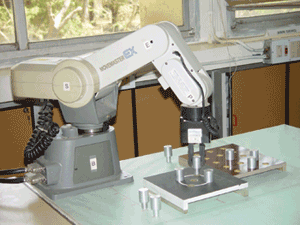 WebROBOT
is an Internet based Assembly Planning System for intelligent task
level programming of assembly robots. Its Client-Server
architecture enables a client to graphically model and synthesize
the assembly world. A feature-based CAD modeler enables the user
to create and position solid models of parts to be assembled in
the virtual world. Unlike the standard robot programming systems
that need Teach-in or Joint level information, WebROBOT enables
the client to specify tasks at assembly (functional) level in a
user-friendly manner. Robust algorithms have been written to
'understand' and process the specified tasks to generate efficient
robot control programs. Specific issues addressed include, grasp
planning, motion planning, collision avoidance, operation
sequencing, and post processing the programs to suit the
controller of the robot in shop. Using this technology, robot
programs can be automatically transferred by the client to the
remote robot site through the server. WebROBOT
is an Internet based Assembly Planning System for intelligent task
level programming of assembly robots. Its Client-Server
architecture enables a client to graphically model and synthesize
the assembly world. A feature-based CAD modeler enables the user
to create and position solid models of parts to be assembled in
the virtual world. Unlike the standard robot programming systems
that need Teach-in or Joint level information, WebROBOT enables
the client to specify tasks at assembly (functional) level in a
user-friendly manner. Robust algorithms have been written to
'understand' and process the specified tasks to generate efficient
robot control programs. Specific issues addressed include, grasp
planning, motion planning, collision avoidance, operation
sequencing, and post processing the programs to suit the
controller of the robot in shop. Using this technology, robot
programs can be automatically transferred by the client to the
remote robot site through the server.
WebROBOT implemented in the modular fashion using Object Oriented
Programming was linked to the Mitsubishi Movemaster 5 axis robot
in the CAM laboratory, and was extensively tested from different
locations through the Intranet. Various assembly tasks such as,
part placement, single and multipart assemblies, and pattern-based
assemblies were tested. WebROBOT was found to provide an efficient
web-based solution from client-end virtual assembly modeling to
its execution in the real assembly environments. The software can
be customized to suit specific robot controllers.
Contact: Prof S S Pande, Mechanical
Engg Department, email: sspande@me.iitb.ac.in |
|
Home
|
Top
| More technologies on next page |
|
|