|
Compensation and Reward
Increasing demands of technology coupled with a short supply of
professionals (with the requisite expertise) has increased the
costs of delivering the technology. This makes incentive
compensation a significant feature, with the result that software
companies have moved from conventional pay-for-time methods to a
combination of pay-for-knowledge and pay-for-performance plans.
With the determinants of pay being profit, performance and
value-addition, emphasis is now on profit sharing (employee stock
option plans) or performance-based pay, keeping in view the
long-term organizational objectives rather than short-term
production-based bonuses. Skills, competencies, and commitment
supercede loyalty, hard work and length of service. This
pressurizes HR teams to devise optimized compensation packages,
although compensation is not the motivator in this industry.
Being ‘the best place to work with’
As with any other professional, what really matters to software
professionals is selecting 'the best place to work with'–which is
what every company is striving to be. The global nature of this
industry, and the 'project-environment' (as opposed to ‘product
environment’) has added new cultural dimensions to these firms. In
a value-driven culture, values are determined and shared
throughout the organization. Typically, areas in which values are
expressed are: performance, competence, competitiveness,
innovation, teamwork, quality, customer service, and care and
consideration for people. Flat structure, open and informal
culture, authority based on expertise and ability rather than
position, and flexi-timings are some of the norms software firms
follow. The idea is to make the work place a 'fun place' with the
hope of increasing loyalty and commitment.
Coping with the Demand-Supply Gap
Shortage of IT professionals is global in nature and not peculiar
to the Indian software industry alone. W. Strigel, founder of
Software Productivity Centre Inc. (1999) has projected the
shortage of software professionals to be one million by 2006. In
fact, a survey reports that 75 per cent of US companies planned to
reengineer their applications using newer technologies, but found
that 72 per cent of their existing staff
 lacked the skills needed
in these technologies, and 14 per cent were not even re-trainable. lacked the skills needed
in these technologies, and 14 per cent were not even re-trainable.
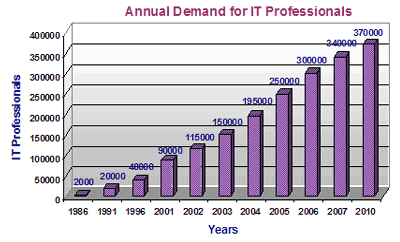
For India, it is predicted that in the year 2004 itself, the IT
sector will need 1,95,000 professionals. This trend will continue,
and in the year 2010 almost 3,70,000 IT professionals will be
required (Strategic Review Reports, NASSCOM 1996-2001).
Consequently, recruitment managers are exploring new sources of IT
manpower from non-IT professional sectors, as well fresh,
trainable science graduates.
Integrating HR strategy with Business Strategy
The strategic HR role focuses on aligning HR practices with
business strategy. The HR professional is expected to be a
strategic partner contributing to the success of business plans,
which to a great extent depend on HR policies pertaining to
recruitment, retention, motivation, and reward. The other major
areas of concern for HR personnel in this context are, management
of change, matching resources to future business requirements,
organizational effectiveness, and employee development. .....more on next page
|
 Editorial