|
Food Process Engineering Mission Projects at IITB
IIT Bombay has developed an appreciation of the challenges, as
well as opportunities in this area over the last decade, and has
played a leading role in conceptualizing a Technology Development
Mission Project (funded by MHRD, Govt. of India) on Food Process
Engineering with IIT Kharagpur, IISc, Bangalore, and several
industry partners. The projects addressed four major areas
described below:
Supercritical Fluid Extraction (SCFE) process1
SCFE process can help the Indian industry to compete in a fast
growing international market for value-added natural products.
Presently, the high cost of imported SCFE equipment deters
economically viable use of SCFE technology. Our objective has been
to develop viable, world-class SCFE technology through indigenous
design and manufacture of components. The SCFE prototype plant
designed and installed at IIT Bombay has state-of-the-art safety
and process control features of commercial SCFE plants. It is used
for technology demonstration, scale-up studies, test sample
(extract) generation, and process optimization. Products extracted
using this technology have the advantages of purity, high
concentrations and extended shelf life. The process allows
flexible operating conditions for multiple product extraction, and
simultaneous fractionation of extract. It also eliminates toxic
residues due to the use of supercritical CO2 as solvent. The
technology has been licensed, and SCFE plants based on this
technology have been sold to industries in India and abroad. More
details at www.iitbombay.com
Controlled Atmosphere (CA) Technology for Long term Storage of
food grains 2
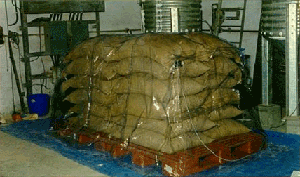 CA storage consists of reduction of oxygen by elevating nitrogen
and/or carbon dioxide concentrations in storage units, so as to
enable preservation of the quality of food products during
storage. The technique of chemical fumigation that is widely used
for storage, although effective to an extent, is not environment
friendly. As an alternative, a Pressure Swing Adsorption N2
generator was designed and established at IIT Bombay. This aids
the creation of nitrogen and/or carbon dioxide-rich, and
oxygen-depleted atmosphere in a storage unit. Bag-stacked items
such as, cereal grains, seeds and black tea have been successfully
stored without any infestation, moisture pick-up, and with
superior quality maintenance in terms of taste, color, lustre and
aroma. The choice of plastic films used as covering material for
the stored grains was based on their gas permeability and water
vapour transmission rates. The work has culminated in the transfer
of the CA technology. More recently another project on black-tea
storage has been executed, and the resulting technology
transferred after filing an international patent jointly with the
industrial partner. CA storage consists of reduction of oxygen by elevating nitrogen
and/or carbon dioxide concentrations in storage units, so as to
enable preservation of the quality of food products during
storage. The technique of chemical fumigation that is widely used
for storage, although effective to an extent, is not environment
friendly. As an alternative, a Pressure Swing Adsorption N2
generator was designed and established at IIT Bombay. This aids
the creation of nitrogen and/or carbon dioxide-rich, and
oxygen-depleted atmosphere in a storage unit. Bag-stacked items
such as, cereal grains, seeds and black tea have been successfully
stored without any infestation, moisture pick-up, and with
superior quality maintenance in terms of taste, color, lustre and
aroma. The choice of plastic films used as covering material for
the stored grains was based on their gas permeability and water
vapour transmission rates. The work has culminated in the transfer
of the CA technology. More recently another project on black-tea
storage has been executed, and the resulting technology
transferred after filing an international patent jointly with the
industrial partner.
Engine exhaust-fired Truck Refrigeration System (TRS) 3
Proper refrigeration is critical to the transport of perishable
items. A novel technology developed at IIT Bombay, which utilizes
engine exhaust has shown encouraging results with both prototype
testing and full demonstration. The engine exhaust-fired TRS can
replace the conventional dedicated engine-driven vapour
compression truck refrigeration system (DEDVCRS) used for
transporting fresh fruits, flowers and vegetables, frozen
vegetables, fish, meat and ice cream. The TRS can be slightly
modified for use in milk transport trucks. The salient features of
the system are: rugged and reliable design due to few moving
parts, low life-cycle costs due to lower initial and operating
costs, and the use of environment friendly ammonia as refrigerant......more on next page
|
 Editorial