|
A similar 'Shipboard Chilling System' for small fishing trawlers
is being transferred to an Indian client for commercialization.
Using these systems, the cost of co-generating power for hot and
cold utilities can be 15 to 50% lower than current methods, where
a significant amount of heat is lost to the atmosphere from the
engine cooling water and exhaust gases. Successful implementation
of these technologies will help reduce fuel consumption, and also
save valuable foreign exchange in importing the DEDVCRS, or its
components.
Liquid nitrogen based Individual Quick Freezing (IQF) technology
for seafood 4
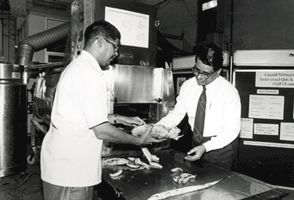 India has excellent potential for development of the seafood
industry, which has emerged as an important foreign exchange
earner. The industry has recognized the need for IQF technology,
which is far superior to the conventional processes in terms of
quicker freezing time, better flavour and shape retention etc.
Compared with the IQF process using mechanical refrigeration
(currently being used in India), the cyrogenic process developed
at IIT Bombay uses liquid nitrogen as the freezant. The seafood is
frozen individually by direct contact with nitrogen vapours and
liquid nitrogen spray. This offers greater convenience to the
consumers and adds value to the products. India has excellent potential for development of the seafood
industry, which has emerged as an important foreign exchange
earner. The industry has recognized the need for IQF technology,
which is far superior to the conventional processes in terms of
quicker freezing time, better flavour and shape retention etc.
Compared with the IQF process using mechanical refrigeration
(currently being used in India), the cyrogenic process developed
at IIT Bombay uses liquid nitrogen as the freezant. The seafood is
frozen individually by direct contact with nitrogen vapours and
liquid nitrogen spray. This offers greater convenience to the
consumers and adds value to the products.
IIT Bombay has indigenously designed and developed a cryogenic
tunnel which possesses the following advantageous features:
-
low initial investment.
-
compact unit–allowing mechanization and automation of the
production process
-
rapid freezing–ensuring retention of original texture, flavour,
and a good marketable appearance.
-
prevention of oxidation of the product due to presence of
nitrogen gas during packing.
To summarize, the projects pursued at IIT Bombay have led to
notable contributions. Besides sensitization to the critical
aspects of food processing and preservation, they have helped
develop a strong knowledge base, expertise, and important
facilities in these areas. The Institute has initiated a
continuing education programme series, including courses on
'Engineering Concepts for Food Industry.' The Ministry of Food
Processing Industry (MFPI) has provided first-phase support for
the development of a modern Food-Process Engineering laboratory at
IIT Bombay. The Institute is now well equipped to launch a
five-year Dual Degree programme in Food and Bioprocess Engineering
(with Chemical Engineering as the core discipline), by employing
the institutional strengths in a wide range of related disciplines
such as: Biotechnology and Bioprocess Engineering, Chemical,
Mechanical and Post Harvest Engineering, Information Technology
and Technology Management.
Contact:
1Prof M Mukhopadhyay (Chemical Engg.) mm@che.iitb.ac.in
2Prof N Shah (*Centre for Technology Alternatives for Rural Areas)
nshah@iitb.ac.in,; Prof K V Venkatesh (Chemical Engg.) venks@che.iitb.ac.in
3Prof M V Rane (Mechanical Engg.) ranemv@me.iitb.ac.in
4Prof K G Narayankhedkar (Mechanical Engg.) nkhedkar@me.iitb.ac.in
|
 Editorial